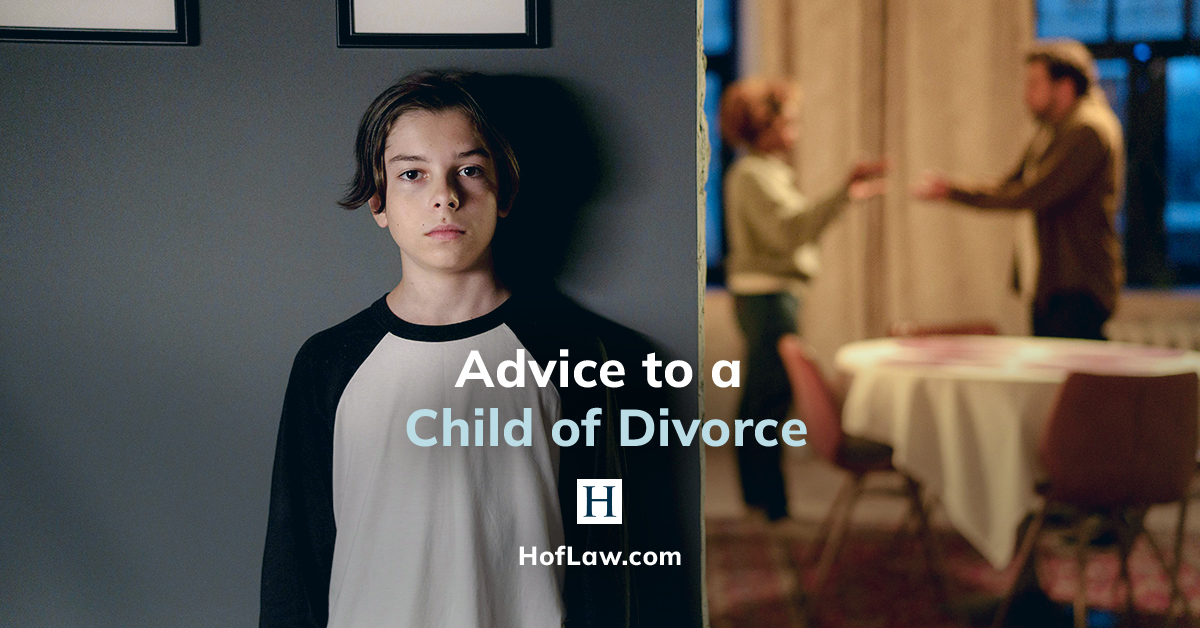
 The other day, I got a family law question I had never gotten before. “Can I ask you about my parent’s divorce?” it read. I had commented on a local moms group, identified myself as a lawyer (hopefully not in an obnoxious, know-it-all kind of way), and this was one of the comments.
“Yes,” I replied, even though I wanted to say no.
But why did I say yes? Well, because I think I’m a softie at heart and – whatever her questions are – I don’t know that I want her going to some other family lawyer, who might not look out for her, protect her innocence, or try to promote her relationship with both of her parents. Whatever she’s experiencing now, I hope to open the door to some kind of understanding that will both help her heal from and grow through whatever she – and her family – are going through.
I don’t usually talk to the kids. When I represent a client, I represent her. I rarely even meet the kids. Over the course of my career, it has only happened a handful of times; often, it’s because I already knew my client before she hired me. Having grown up in the same area where I’m now practicing law, it’s sort of an occupational hazard. I’ll know some of the women. Of course, that means that some of the people I know would probably rather never talk to me about it. To others, me being someone that they know is a boon. To each her own.
But what would I say? A couple of things, depending on what exactly she ends up asking me.
-
You really shouldn’t go digging through the details.
Humans are complicated. Your parents – and me and mine and everyone else on the planet – are human.
They are going through one of the most overwhelming and difficult experiences of their adult lives. It’s bound to be messy.
Though they shouldn’t, they may try to involve you. Whether we like it or not, sometimes our parents make mistakes. They talk badly about each other. They overshare. They make their grief their children’s problem. They struggle with emotional regulation. They use children as the messenger; they put them in the middle.
Whether their child is a literal child (which I’m going to define as 18 and under) or an adult child, it doesn’t really matter. In fact, I’ve heard before that for adult children, divorce is often even more difficult than it is for younger, often more adaptable children.
As someone who has practiced family law for many years now, I will say that you should not get all of your information from just one side. It may be that they are representing the situation accurately, but more often I find that – whether they’ve done so deliberately or because they don’t actually understand everything that is happening – there is a lot left out when you only hear from one party.
Unless your parents’ divorce is one that involves abuse, try to give both the benefit of the doubt. You can listen, if you like, but you can also enforce a boundary. “I’m sorry, dad – I prefer not to hear the details,” or, “Mom, I love you, but I can’t give you the support that you need on this.” Use your best judgment and don’t be afraid to adapt as you go.
You don’t need to know the details of their court order or separation agreement, either. You may – to some degree – be familiar with custody and visitation arrangements, but you don’t need to know all of the details.
-
Your parents should not ask you to choose.
In no form or fashion should your parents ask you to choose a side, whether in an emotional sense – I’m not talking to this parent because of how they treated that parent – or in the sense that you would be consulted on where and with whom you’d like to live. In some states, it is possible for a child of a certain age to express a preference, but usually the child does not testify to that fact in open court in front of their parents. This is considered (and rightfully so, I think) too damaging.
In Virginia, in a case where the parents can’t agree with respect to custody and visitation, there is often another attorney appointed called a Guardian ad litem. It is this attorney’s job to interview the child(ren) and, ultimately, to make a recommendation to the court. In cases that I’ve had where the child’s preference comes in, it is usually through the Guardian ad litem’s report.
If you wanted to, you could talk to your Guardian ad litem about your preference and your reasoning. In Virginia, depending on the age, maturity, and experience of the child, it’s possible that your preference would be given weight, but it is not automatic. Once, I had a case where the child told the Guardian ad litem his preference, but asked that the Guardian ad litem not tell anyone because he didn’t want to hurt either side. (For the record, she did not disclose the child’s preference during our hearing.) Whether you discuss this with the GAL or choose to keep it close to your heart, you should know that you can ask the GAL not to say that this is your preference or not to disclose it at all, if you’re afraid of hurting your parents.
If you’re over 18, you can go where you want and spend time how you want. Though your parents may put pressure on you to spend your time in a certain way, from this point onward it is entirely your choice.
-
Talk to a therapist.
I’m a lawyer. I am not a therapist. What you are going through is real and profound and traumatic and you deserve to have your own listening ear. (Your parents should follow this advice, too.)
Whether you are an adult or a child, what you are going through is a big deal. You deserve to have someone working with just you on whatever parts of this are most difficult for you. You should be able to speak freely and be honest with someone in your life. Your parents may or may not be able to be that for you right now – they’re going through their own stuff – so you need someone who can help you through. Someone who is always in your corner. Someone whose feelings you won’t hurt by being completely honest or saying the thing that you can’t say to someone who has skin in the game.
-
It isn’t your fault.
I’m sure you know this on some level, but you should know that things go wrong in adult relationships for a million different reasons. Whatever has happened between your parents is not because of you.
It’s not fair to ask you to be the grown up – even if you are literally an adult. It’s not fair to tell you that you should extend as much grace and compassion as you can. Nothing about any of this is fair. But, most of the time, divorcing people are just like everyone else. Wildly flawed but fundamentally trying their best in a world that they – and none of us, really – could ever truly be prepared to face.
Though you probably want details, or worry that important information is deliberately being kept from you, the details probably won’t make you feel better or help you heal. I said this before. But it really probably is enough to hear – and, eventually, to know – that it isn’t your fault.
-
If there’s abuse involved, nothing else matters.
All the rest of my advice today is geared towards normal people in normal divorces. Not all situations are normal. In my practice, I’ve seen some terrible situations that involve all sorts of abuse.
It is disingenuous – and maybe even gaslight-y – for me to tell you that both of your parents love you or are doing the best they can for you or to give them grace if one of those parents is an abuser. If you have witnessed abuse, if you have experienced it yourself, you will have a longer, more difficult road to travel than others.
As an adult, you may choose to handle what you’ve experienced in your own way.
Your parents’ marriage has both nothing and everything to do with you, but it isn’t your fault and you are not alone. It is hard and isolating and, in some cases, profoundly traumatic, but it isn’t your weight to carry. That doesn’t mean that you aren’t carrying it – just because you’re here suggests to me that, in some ways, you are – but I hope that with repetition and help (again, therapy is great!) you can move past this and focus on what comes next for you in your own life.
Whether you choose to continue your relationships with your parents as they exist or modify things – especially as you get older and have more control over how and where you spend your time – I hope you will do so with clarity and your own health and well-being in mind. What happens next is up to you.